Friday, September 26, 2008

Bible Code Skepticism

After an interesting, but hopelessly short, discussion with a good friend last night on the topic of the so-called Bible codes, he wanted to know why I was skeptical. Basically, it is claimed that hidden prophecies can be uncovered in the Bible through computer-aided statistical analysis. Once a passage of Scripture is laid out in a grid, letters can be read in a crossword puzzle-like grid. Words and phrases can then be read by combining letters along this grid work. Believers claim that codes can be found in distinct patterns referring to the Holocaust, President Kennedy’s assassination, even 9/11. (I found this article interesting because it apparently predicted events that should have happened two years ago: http://www.halexandria.org/dward420.htm.) In essence, believers claim that this represents the “fingerprints of God”.

As I told my friend, I am skeptical. Firstly, I believe that the Bible is given to us by God (what that exactly means, as you may have noticed, I don’t exactly know). That said, these hidden prophecies, if they exist at all, do not necessarily add anything to the awe I feel about the Bible. In some ways, it detracts from it, because, if, as I suspect, these codes are really just artifacts of chance and how the experiment is set up, it makes it appear as if there is really nothing miraculous about the Bible. While I think it is completely possible for God to put these codes into the Bible, I can’t really see why He would if we appear to only be able to decipher messages about the past.

Additionally, the scientific skeptic in me wants to see what other dispassionate (if that is possible) researchers have to say about the topic. A number of credible researchers find fault with the methods, most notably Dr. Barry Simon, PhD. Indeed, the codes have been seriously questioned as early as 1994. I’m sure, if I gave Google a little more time, I could come up with more research to at the very least make me wonder.

Labels: , ,

Tuesday, November 27, 2007

Ghosts and Christians

Over the past few years, my wife and I have been watching the Sci-Fi Channel’s "Ghost Hunter" series. For us, watching the trials and adventures of TAPS (The Atlantic Paranormal Society) has been an entertaining and thought-provoking experience. I enjoy "Ghost Hunters" because they truly seem to be trying to be rational, yet open to every possibility. They don't go in trying to prove that a place is haunted. Rather, they try to see where they can explain, in material terms, the so-called paranormal activity. I respect the sober and cautious manner in which they approach their work. They recognize that there are risks involved with the use of Ouija boards, and seem to agree (generally) with a Biblical view of demons (Demonology FAQ's). This gives me the sense that they are not trying to hype or exploit the supernatural like so many other show does.

But where does that leave a Believer? Aren't we told that ghosts don't exist or that communication with such beings are strictly forbidden? Are we not repeatedly warned to avoid spiritualism in any form?

Let's start with what the Bible has to say. As highlighted by the folks over at Got Questions, there are several passages in Scripture that may shed some light on ghosts and haunting. Let me quickly retell their findings and add some of my own:
  • In 1 Samuel 28:7-19, King Saul seeks a woman with a familiar spirit (demon) to inquire of Samuel about what to do. That she actually manages to communicate with the dead shocks her (v. 12) indicating to me that it did not previously happen.
  • In Matthew 17:1-8 and Mark 9:4, Peter, James and John see Moses and Elijah with Jesus for a brief period of time. Dead people from the past can, at least on some occasions, be seen by the living.
  • In Luke 16:19-31 Jesus tells the story of the rich man and Lazarus. In this story we learn of there being two compartments for the dead until the Great White Throne Judgment (Revelation 20:11f.). Also in the story the rich man asks for Lazarus to be sent back to warn the living. Abraham says it would do not good because if they will not believe God's written word, they will not believe though one should rise from the dead.
  • Luke 24: 36-43 tells about how the disciples reacted when Jesus greeted them after the Crucifixion. He surprised them by suddenly showing up, thinking He was a ghost. "He said to them, 'Why are you troubled, and why do doubts rise in your minds? Look at my hands and my feet. It is I myself! Touch me and see; a ghost does not have flesh and bones, as you see I have.' When he had said this, he showed them his hands and feet. And while they still did not believe it because of joy and amazement, he asked them, 'Do you have anything here to eat?' They gave him a piece of broiled fish, and he took it and ate it in their presence.
  • 1 John 4 tells us that there are a variety of spirits, many of which are not to be trusted.
  • Hebrews 12:1 tells us that there are many witnesses to our daily lives (this probably means angels of some kind, but it's not entirely clear to me what is being referred to here).
  • Ephesians 6:12 indicates that there exists invisible, fleshless "powers" throughout the "heavenly realms".
  • 1 Timothy 4 indicates that there are deceiving spirits and there are demons.
  • God finds detestable the "practice of divination or sorcery, interprets omens, engages in witchcraft, or casts spells, or who is a medium or spiritist or who consults the dead." Deuteronomy 18:11-13.

As you can see, the Bible does not appear to be silent on the topic of ghosts. That said, I'm struggling to put together a coherent argument based on the Bible. But here's the general principles:

  1. One or more non-physical dimensions exists which are overlapping of, adjacent to, or perhaps parallel to the physical world.
  2. Various spiritual beings inhabit these dimensions (some seem to be good, others evil, and others still of unknown alignment).
  3. Human spirits continue on after death and may be able to interact on some level with the living.
  4. Because we can't necessarily tell what these beings want, we should avoid them, turning only to God for spiritual connections.
According to the Bible, the spirit of a Believer goes to heaven, while unbelievers go to Abraham’s Bosom, Sheol, Hades, Purgatory, or Hell (depending on your background and biblical interpretations). What and where exactly these places are, I am not sure. But it seems to me that According to one perspective, "Purgation involves purification of sins and these include worldly attachments. It is the souls with worldly attachments that manifest as ghosts on earth. Other souls also manifest in different ways mostly in dreams. Their purpose is the same i.e. to have prayer/masses said on their behalf." On this view, it seems likely that one form of purgatory might be an after-life existence fettered to a cherished place or thing in the physical world. Thus, it seems not unlikely that human spirits could remain unable to "move on" until they have completed some form of penance. Beyond that, I can not make any dogmatic statement concerning the fate of a lost soul (for I do not really know or understand what Hell is, beyond "a separation from God and an acute knowledge of that separation").

While I do not hold that there is a conflict between the belief in ghosts and basic Christianity, the Bible's admonition to avoid contact with spirits not of God seems sound and reasonable. If I accept that saved souls go to heaven, that leaves me with the likelihood that unsaved souls become ghosts (obviously, there are a few exceptions (Matthew 17:1-8, Mark 9:4, 16:19-31), but intentionally seeking out these spirits seems to be unwise at best, because we do not even begin to know what their motivations are.

Need we fear these spirits though? Absolutely not. We, disciples of Christ, have power over evil spirits (Matthew 10:1). We can, also, be comforted by the fact that our existence after we die will not be eternal one of moaning, chain-rattling undeath. Rather, our spirits will meet with Christ in heaven.

Labels: ,

Tuesday, November 20, 2007

The Bible as the Word of God

The Bible has always fascinated me. Even when I was an atheist, the stories and explanations seemed intriguing. Yet I have always wondered how people can draw the conclusion that, according to my church, "The Bible is our final authority in every area of faith and practice." It seems reasonable, but what exactly does that mean? What about reason, interpretation? What about cultural differences and perspectives?

Let's look at what the Bible has to say about itself:

  • "All Scripture is God-breathed and is useful for teaching, rebuking, correcting and training in righteousness, 17so that the man of God may be thoroughly equipped for every good work." (2 Timothy 3:16-17)
  • "These are true words of God." (Rev. 19:9)
  • "Did the word of God originate with you? Or are you the only people it has reached? If anybody thinks he is a prophet or spiritually gifted, let him acknowledge that what I am writing to you is the Lord's command. If he ignores this, he himself will be ignored." (1 Corinthians 14:36-38)*
  • "Above all, you must understand that no prophecy of Scripture came about by the prophet's own interpretation. For prophecy never had its origin in the will of man, but men spoke from God as they were carried along by the Holy Spirit." (2 Peter 1:20,21)
All of these passages declare that God initiated what we now call scripture (or "prophecy") and that what we have in the Bible is "true".

I don't put quotation marks around the word true to be cute or make some oblique deconstructionist comment. I am not really venturing into a metaphysical argument either about the Bible's origin here. Rather, I am saying that the authors of the Bible recorded, as best they could, the words of God Himself. Note too what these passages are NOT saying:

They are not saying that every detail, every word, turn of phrase and punctuation is perfect. God did not reach down and write the Bible Himself. Rather, He prompted men to transcribe, for lack of a better word, what the Holy Spirit lead them to write. (Perhaps, it might be best to describe the process as transliteration from the Language of God to Hebrew or Greek.) The Bible is also something that requires some effort and faith to understand; it requires interpretation and application before it truly is the Word of God. Without our effort and the work of the Holy Spirit, it is possesses no power on its own.

To say that the Bible is the "final authority" may be correct in a pragmatic sort of way. Without the Bible as a uniform code of behavior and practice, we certainly would have a much more difficult time defining the word "Christian". How would we know what a Christian is if we had no recourse to the unifying set of beliefs represented by the Bible? Obviously, we wouldn't. That is why the Bible, as the Word of God, is useful as the binding document for Christianity.

The Bible claims that it's words are true, should be heeded as important and useful. They originate with and flow from God Himself. The Bible can make us "wise for salvation through faith in Christ Jesus" (2 Timothy 3:15); we can grow in our understanding of life and spirit when we put our hearts and minds to the task of learning from it. Certainly, I believe this to be so.


* or, perhaps more fitting, "If he is ignorant of this, let him be ignorant."

Labels:

Tuesday, August 2, 2005

Gospel Errors in Timing

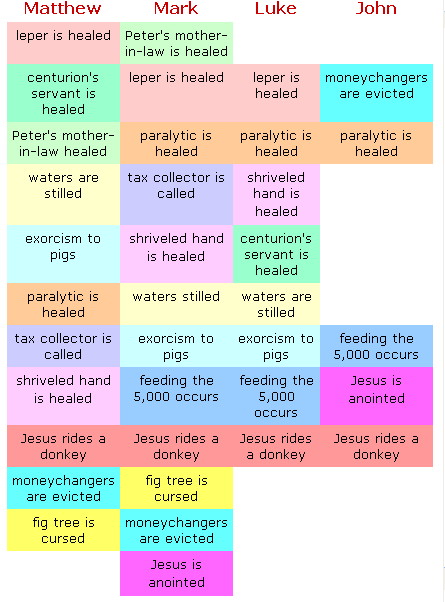
As a trained historian, I always find it odd that Christians claim that the Bible should be viewed as a historical document. It's clear to me that the Bible was written in a historical context, and there are endless points of historical correlation, but the Bible is a spiritual book, not a book of pure history. As pointed out in this "Gospel Errors in Timing", there are clear inconsistencies in the historical sequences presented in the four Gospels:
If a prophet is having a vision one might expect the sequence of events to be jumbled up - much like a dream. However if an historical narrative is being given the sequence of events should be in proper order. The Gospel of John is written from a different perspective than the synoptic gospels so it might be expected that it would differ in chronological order from the other gospels. The interesting thing is that even among the synoptic gospels there is considerable difference in the order of events.
Does this mean the Gospels are wrong or historically valueless? The simple answer is no. It makes sense though to look at the Gospels as they were intended: not a history with theological implications, but theology with historical implications. Each of the Gospel writers was trying to communicate something beyond the mere chronology of Jesus' life. When things happened were not as important as the fact of their happening. In addition, the placement of certain events into the structure of each book was (probably) meant as a point of emphasis (at least that's how I write about real life events as it relates to a bigger message). Finally, we are dealing with human authors here; I believe that God did play a role in the authorship of the Bible, but that doesn't mean men didn't have the opportunity to mess things up.

In my mind, that does not diminish the message as radical skeptics would argue. Nor does it strengthen the truth of the Gospels. It simply demonstrates that each of the Gospels was written with a slightly different message in mind and that each Gospel was written, not as historical narrative but, rather, as a testimony to the spiritual truths found in the historical person of Jesus Christ.

Labels: