Wednesday, November 21, 2007

Ancient Giant "Bug" Discovered

Buried in 390-million-year-old rocks, scientists have recently discovered the claw to an extinct Eurypterid (sea scorpion), Jaekelopterus rhananine. With the possible exception of the Arthropleura, this is the largest arthropod ever discovered. As reported by the Royal Society, the complete animal was about 2.5 metres long (a little over 8 feet).

Why these creatures grew to such lengths, no one is sure. Two possible explanations: greater amounts of oxygen in the atmosphere and a lack of predation. A correlation between the increase of carbon dioxide and (predatory) jawed fishes and the extinction of the Eurypterids?

Labels:

Saturday, October 27, 2007

Redheads are Neaderthals!

It seems that we red-heads may just be descendants of Neanderthals. Apparently, a very similar mutation of the MC1R gene may have affected Neanderthals in much the same way as in modern humans, producing red hair and light skin color. This leads researchers to suggest that Neanderthals interbred with modern human populations.

Another reason to hate Ginger kids?!?

Labels: ,

Wednesday, February 15, 2006

Darwin's Warm Pond Theory Tested

On of the things that has always caused me to be skeptical of the Darwinian view of the origin of life is its inablility to explain how basic cellular building blocks came together in the first place. A cell cannot function without a very specific combination of amino acids, which at the start, requires the blue-prints found only in DNA. DNA does not exist in the wild, but amino acids do. What Darwin, and his followers, suggested is that life began when the raw chemicals of life found themselves in a "warm little pond" somewhere in the world a very long time ago. This theory is now being tested.

Unfortunately, the results do not bear out Darwin's theory. For nearly 100 years now, volcanic clays were thought to be the perfect place for the origin of life. But it turns out that surface of clays in warm to hot water do not polymerize sufficiently to cause organic molecules to form. In fact, according to resent research, clay binds to the organic compounds in such a way that no further growth can be measured.

I'm not about to suggest HOW God did it, but it's clear to me that the only way to get life in the first place is through some miraculous process. The origin of life, from a purely physical, scientific view is completely paradoxical. So, according to the article in question, we are required to push the origin of life back into outer space. Which only defers the question to speculation, unless one is comfortable with the idea of an all-powerful Creator. Next thing we know, we'll just skip Christmas and celebrate Darwin's birthday . . . oh wait, we are!

Labels: , ,

Wednesday, August 24, 2005

Evolution and the Myth of Creationism

Since being involved in a number of evolutionary debates over the past few weeks, I decided to pull out Evolution and the Myth of Creationism by Tim M. Berra and give it a thorough and open-minded reading. This is one of those books I skimmed through when it was assigned (I believe it was for my mini-semester upper division evolution cram-class) but I didn't have time enough to really sink my teeth into.

The subtitle, "A Basic Guide to the Facts in the Evolution Debate", is a good way of describing the book. It's a fairly short book, only 198 pages, including a couple very nice appendixes and gives plenty of detail needed for Berra's argument:
This book has three related purposes. First, it is an attempt to explain evolution to people who are genuinely confused by the claims of creationists, who try to present fundamentalist Christian beliefs as science. Second, it sees to provide useful ammunition to the high school biology teacher or school board member who finds himself or herself under attack by creationists. Third, it should be a useful supplemental text for introductory college-level classes in biology, zoology, botany, or anthropology. These three purposes can all be served by answering the following question: What should an educated person know about the theory of evolution?
Berra does a good job in all three areas. If you can get past the author's obvious distaste for anyone who finds creationism--in any form whatsoever--even mildly acceptable, any reader should come away with the beginnings of an answer to his question.

It's when Berra gets to his third chapter, The Explanatory Power of Evolution, that his argument begins to loose steam. Because Berra dismisses "creationism" or anything that doesn't quite fit his worldview, he misses those points of commonality where just maybe Intelligent Design or creationism at large isn't as lacking as he assumes. For example, the Peppered Moth and the case of English air pollution. What Berra fails to note is that Intelligent Design and other creation models would make the same prediction as evolution concerning the return of a larger number of light colored moths when the environment lightens up due to a reduction in soot.

It's the assumptive power of evolution that bothers me, more than a simple recitation of biological facts. The presumption that only evolution can explain the evidence also gets a little annoying. While Berra does a good job refuting some of the silly arguments that can be heard on TBN's Creation in the 21st Century, both Dr. Baugh and Dr. Berra parade out philosophic arguments masquerading as science. In Berra's case, he assumes that, because small changes can be seen, large changes can be explained because of those small changes. It's a very logical deduction. Unfortunately, it's a bit of a hasty conclusion that explains everything.

That's not to say that I dispute the basic facts of "evolution", read biology: there were some pretty strange creatures running around (Archaeopteryx to Australopithecus) and there are some pretty amazing biological adaptations (Sickle Cell Anemia and its relationship with Malaria, for example). I'm also pretty sure the earth is more than 6,000 years old. These are the facts that should be taught in school. "Education," Berra says, "does not exist to confirm people's superstitions, and children do not learn to think when the are fed only dogma" (p. 139). While I heartily agree, I find it odd that the author does not see the dogmatics in his own writings.

Labels: ,

Thursday, August 11, 2005

Faith-based Evolution

Apparently this "Evolution Week" on Lee's Walk!

Evolution is a tricky subject. While I am no expert in biology, I can make reasonable assessments of any argument. Evolution is a theory, an argument in the philosophical sense, that can be evaluated on it's logical merit. That said, does the acceptance of evolution require "faith"?
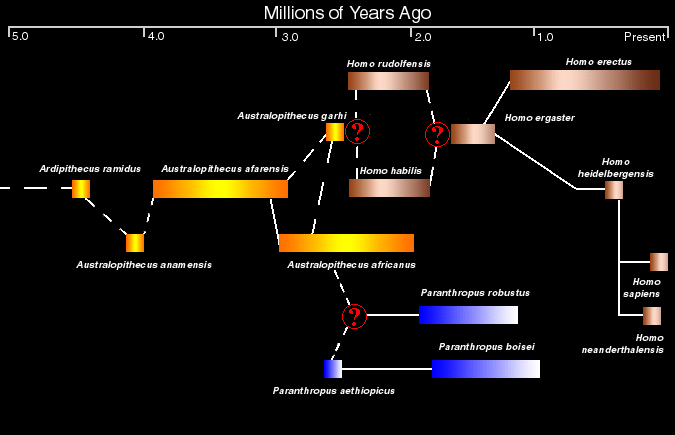
Early Human Phylogeny, Smithsonian National Museum of Natural HistoryI wouldn't go so far as to call evolution a religion, but I don't see how some people argue that evolution requires no faith at all to accept. I'm guessing that the vast majority of people in the United States couldn't succinctly define "evolution" much less logically defend it with strong factual evidence. My suspicion is that of those people most believe that the theory is an accurate descriptor of reality. That leads me to the conclusion that most people have faith in the theory or, barring that, faith in experts who believe the theory.

That's fine and good; most of us take as a matter of fact that the earth revolves around the sun even though we have no direct proof (we have to defer to cosmologists, physicists and mathematicians for that). We have faith in a lot of things that are, in reality, fact simply because we, as independent observers, cannot confirm or deny in a purely scientific manner. On a logical level, it may be justifiable to believe in evolution based on all available facts, but not to make fallacious appeals to belief (i.e., "evolution is true because I believe it to be") or appeals to authority (i.e., "Charles Darwin and Stephen Jay Gould believed in evolution, therefore I do").

So, what are we left with?

We are left with several facts about human evolution. Simply put, we possess the following facts about human origins (taken primarily from my old college text books, Reconstructing Human Origins, The Human Evolution Sourcebook, The Human Evulotion Sourcebook and Early Human Phylogeny, Smithsonian National Museum of Natural History):
1. There were several species of creatures who possessed anatomical similarities with modern humans and apes
2. These species had a geologic life span and then died off
3. Fully human (homo sapien sapien) appeared at a specific time in the past
You can infer several things from this in a logical way. Either, these species were related chronologically, one giving rise to another with various branches and dead ends, or, these creatures had similar design properties but are not directly related. Either conclusion is inductive; there's merely a probability that either is correct.

In addition the idea of a "missing link" or transitional form is purely subjective. You are free to interpret the data in a way which makes it likely that there is a genetic line between Australopithecus through to the Homo genus to modern man, but you have to admit that this is an interpretation of the facts, not the facts. (If Darwinian evolution is true, I'd expect to see no distinct species in the past, rather a blur of characteristics that defy classification.)

So back to the point: does evolution require faith? Dr. Roy W. Spencer, Principal Research Scientist, University of Alabama apparently does. I'd say that in general he is correct. Evolutionists believe in the unseen truth (untestable connections between Australopithecus and us today. There may indeed be connections there, but they are logical artifacts rather than concrete facts.

Labels: ,

Wednesday, August 10, 2005

Some Reviews of "Ape to Man"

Here's a few reviews of "Ape to Man":

Social Studies for Kids says:
This show is an excellent introduction to the topic for teens and younger viewers and a good refresher course for adults who might have heard about Piltdown Man and 'Lucy' but forgotten relevant details. Check it out!
The show is a pretty good brief introduction to the subject as a matter of history, but still doesn't help anyone understand evolution in any concrete ways.

Underground Online:
It must be noted that Ape to Man does not address the current Creationism debate. Perhaps they do not wish to offend anyone by either taking a side or even not taking a side. There is nothing wrong with that. Unfortunately, this laissez-faire attitude has forced them to avoid some topics that inevitably will cause uninformed people to question things that are not answered in the program. For instance, how species actually evolve from one species to another is not really addressed. Is this a plot hole of the show or evolutionary theory itself? Also, some of the assertions boldly proposed by the program as little less than fact, such as the coexisting of Neanderthals and Homo sapiens, are apparently still in debate by anthropologists. The show doesn't mention this debate, but it is addressed in the Funk and Wagnall encyclopedia entries on the History Channel's own website! Was there no time to present differing anthropological views or did the writers fear that presenting a difference of opinion in the scientific community would be used by Creationists as a sign of weakness in the whole evolutionary theory?
This is exactly my problem with "Ape to Man"; the main issue of what evolution is never addressed. Once again, the show was a historical representation of the advances of anthropology over the past two centuries, so it can safely avoid in depth biology.

Pharyngula writes:
Conclusion: the show was interesting when it discussed the recent history of the discoveries, and rather aggravating when it tried to portray the lives of ancient hominids. It definitely did not pander to creationists, though, so I'll give it a passing grade.
Yeah, I tend to agree, the show wasn't bad, just OK for what it was. Indeed, it didn't pander to Creationists, but, as the writer points out, it didn't necessarily help the "other side" that much either.

Apologetics Press opines about the "alleged confrontation between Neanderthals and Homo sapiens":
So, we have conquered and eliminated all other hominid species. Or could it simply be--there were no other species? That from the very beginning, there has only been men and apes? While arguably retaining some entertainment value, this expensive production was anything but history. In fact, this type of Hollywood propaganda would be better suited for the Cartoon Network, or the Sci-Fi channel. If a channel purports to convey actual history, and names itself accordingly, then speculation and misinformation should be left on the editing-room floor. That's where this production belonged.
A little harsh but not without merit. As has been pointed out, the show never really presented a clear picture of it's message; if it was really about the history of evolution, not evolution itself, it failed to address some major issues, and if it was really about the science of evolution, then it left gapingng holes in it's argument.

Labels:

Tuesday, August 9, 2005

"Ape to Man"

History warns us that it is the customary fate of new truths is to begin as heresies and end as superstitions.
Thomas Henry Huxley, 1880
Even though I’ve taken well over a 2 years of college biology, especially genetics and evolution, I have yet to be convinced by the “evidence”. Despite my education, I am still hardily skeptical about evolution. Honestly, I’d rather just believe in evolution and call it a day—it certainly would be easier—but I find that the common portrayal of it leaving me with too many questions.

Sunday night, the History Channel aired it’s much lauded “Ape to Man” program and, as per usual, I spent most of the two hours asking: “Now, how in the world do they know that?” There are reasons for their assertions (aren’t there?). Unfortunately, the program never even attempted to explain HOW evolution worked; Evolution was merely assumed to be true. How did the scientists know whether or not H. habilis had hair, whether it had “evolved” sweat glands? In the end, the biology in the show was great story-telling, filled with drama and plausibility. I personally enjoyed it, but I recognized it for what it was: fiction.

OK granted the show was not an attempt to teach biology but rather it was designed to teach history (while masking as an attempt to teach biology). One of my main concern along these lines is that the show spent no time at all on Charles Darwin. The narrator made several statements to the effect that Darwin had nothing to say about human origins. Umm did someone forget his 1871 book entitled, The Descent of Man, and Selection in Relation to Sex? Maybe the book wasn’t as exciting as the 1856 discovery of Neanderthal bones, but that’s no reason to misrepresent Darwin’s contribution to anthropology. Unless the authors didn’t want to expose Darwin’s “social” agenda. I’ll leave you with a couple choice quote from that book:

With savages, the weak in body and mind are soon eliminated; and those that survive commonly exhibit a vigorous state of health. We civilized men, on the other hand, do our utmost to check the process of elimination; we build asylums for the imbecile, the maimed, and the sick; we institute poor-laws; and our medical men exert their utmost skill to save the life of everyone to the last moment. There is reason to believe that vaccination has preserved thousands, who from a weak constitution would have formerly succumbed to small-pox. Thus the weak members of civilized societies propagate their kind. No one who has attended to the breeding of domestic animals will doubt that this must be highly injurious to the race of man. It is surprising how soon a want of care, or care wrongly directed, leads to the degeneration of a domestic race; but excepting in the case of man himself, hardly anyone is so ignorant as to allow his worst animals to breed.
(Charles Darwin, The Descent of Man, and Selection in Relation to Sex, Princeton: Princeton University Press, 1981, p. 168, vol. I.)
Hmm so there are "worse breeds" of people, people who should be allowed to die off because they are "weak". Vaccination is bad because it lets weak people live when they should not!
At some future period, not very distant as measured by centuries, the civilised races of man will almost certainly exterminate and replace throughout the world the savage races. At the same time the anthropomorphus apes, as Professor Schaffhausen [one of many German social Darwinists] has remarked, will no doubt be exterminated. The break will then be rendered wider, for it will intervene between man in a more civilised state, as we may hope, than the Caucasian, and some ape as low as a baboon, instead of as at present between the negro or Australian and the gorilla.
(Darwin, Descent, p. 201, vol. I.)
Sounds familiar, no? You thought that was something Hitler would say, right?
Man scans with scrupulous care the character and pedigree of his horses, cattle, and dogs before he matches them; but when he comes to his own marriage he rarely, or never, takes any such care. He is impelled by nearly the same motives as are the lower animals who left to their free choice, though he is in so far superior to them that he highly values mental charms and virtues. On the other hand he is strongly-attracted by mere wealth or rank. Yet he might by selection do something not only for the bodily constitution and frame of his offspring, but for their intellectual and moral qualities. Both sexes ought to refrain from marriage if in any marked degree inferior in body or mind; but such hopes are Utopian and will never be even partially realized until the laws of inheritance are thoroughly known. All do good service who aid towards this end. When the principles of breeding and of inheritance are better understood, we shall not hear ignorant members of our legislature rejecting with scorn a plan for ascertaining by an easy method whether or not consanguineous marriages are injurious to man.
(Darwin, Descent, pp. 402-403, vol. II.)
I can't wait until we understand all the "principles of breeding and of inheritance", then life will be grand! Oh wait, the History Channel just said we now know all . . . hrmm.

Labels: ,