Tuesday, October 21, 2008

On Being a 'Thoughtful' Christian

I started writing about my Christianity a couple of years ago while in the middle of a crippling bout of depression. My councilor wanted me to double check some of my assumptions, history and associations I had to see if anything in Christian life, either due to faulty thinking or unhealthy habit, may be contributing to those dark thoughts. What follows is the concluding remarks from my 'book' on how I became a Christian.

Rightly or wrongly, I, probably, will always be a little suspicious of people who have been Christians their whole life. They were born Christian and will die Christian. I wonder, hopefully not too cynically, whether they have actually made a choice to become a Christian or was that simply the default setting, as it were? Did they ever come to a point when they made Christianity their own? Have they ever really had to struggle with the difficulties involved in accepting the Bible the way I have? Have they ever been “bad” enough to realize what they’ve been saved from? Do they ever actually philosophize about their faith or is it a purely reflexive worldview? Granted, this suspicion may, in some part, be born out of a sense of envy; I wish sometimes that I didn’t have to struggle as much as I do with my faith. I wish it was as easy as some Christians seem to want me to believe, especially when I so often feel like a weird space alien where ever I go.

Dr. Brian Leftow, professor of philosophy at Forham University, says “I am a philosopher because I am Christian.”[1] I suspect for many modern people that makes little or no sense, but to me, I could never see it any other way. This claim, of course, is a problem for both the theologian and the philosopher. Philosophers tend to think religion isn’t worth the trouble, and theologians tend to think philosophy is more trouble than it’s worth. Philosophy is an act of the mind and will, which is often seen as unreliable “fleshly wisdom” by the religious. Religion, on the other hand, is seen as too subjective to be rationally examined by the philosopher. Both sides, though, are equally guilty of calling out the Thought Police. In Christian circles, it is quite alright to think and question, as long as you think correctly and quickly accept the right answers to your questions, and, in philosophic circles, is quite alright to be Christian as long as your faith does not contaminate your intellect and interfere with your quest for the “truth”. Both sides eye each other with suspicion and both sides too often take their point to an absurd extreme.

I seem to be reasonably well suited to live with uncertainty. I have always been fairly pessimistic about the world, people, the future, but I have always been able to navigate the tensions between my Christian faith and the rigors of reason in an almost aloof sort of way even as faith and reason seem to be polar opposites.[2] For example:

  • Faith is stable, eternal. While reason is always tentative, speculative, probing.
  • Christianity is orthodoxy. Reason requires testing new ideas; it requires avoiding the crowd (Kierkegaard) or herd (Nietzsche) mentality and anything that interferes with sober thinking (Marx).
  • Faith is seen as the opposite of reason. Faith is the evidence of things unseen, while reason requires evidence and argument. Faith is subjective; reason is objective.
  • Intellectual pursuits are often seen as unimportant in the light of God’s eternity.
  • Intellectuals are seen (often rightly) as the enemy of the Church.

It is sometimes difficult to maintain a sense of worth when you “sit on the fence” the way that I do. While Church and Academia so often stand in open hostility, the world at large generally isn’t much help either to the self image of a philosophically minded person. Popular culture is extremely pragmatic; it wants to know how to get something done. Being a “thoughtful” Christian doesn’t usually produce anything of practical use. The education we all receive in school is extremely utilitarian; you need to learn enough to get a job. Thought life is not necessarily entertaining, quick or upwardly mobile. So, my questions are generally kept to myself. I have to pick and choose my battles, and make sense of all this religion-talk as well as I can away from the prying eyes of the Church, Academia and the world at large.

My questioning is sometimes more accepted in secular circles, though. In the Church, I often am met with offended stares if I openly raise questions or present opposing viewpoints. (Though I think in some circles this is becoming less of an issue.) I’ve been told by very well meaning Christians, that my methods are completely wrong. That I just need to stop questioning and “surrender to Jesus”. OK, so how should I do that, I ask. The answer usually is something like: just read the Bible and all your questions will be answered.

This solution to the problem is, for me, entirely insufficient.

While obviously I believe the Bible is the “Word of God”, I still struggle with some of the same old questions about its authenticity, accuracy, legitimacy and its moral lessons. Some parts of the Bible are easy to grasp and accept. Others are not. If we are honest, we all have our favorite books, passages and verses in the Bible and (if we are being honest with ourselves, right?) we are guilty of completely ignoring certain passages in the Bible that are difficult to understand, or that the meaning is at odds with our current views. We act as if certain passages are divine commands for everyone and at all times, yet deliberately break others. We take verses and parts of verses out of context to fit our own needs. Indeed, whole religions and denominations have sprung up because of this tendency. For example, I seriously doubt the Mormon Church would be what it is today if John 10:16 (“And other sheep have I, which are not of this fold . . .”) did not exist.

That said, it should come as no surprise that I believe that this isn’t always a bad thing. Every human being is different, with different backgrounds, needs and desires, giftings and purposes. For myself, I will honestly say there are things about being a Christian (and being a Christian probably means, in the final analysis, believing what the Bible has to say) that are anything from mildly disagreeable to down-right offensive (rightly or wrongly, I’m still working that out). There are things also that seem to completely contradict what I think the rest of the Bible is saying about God. There are things in the Bible that I don’t understand and there are others that I flat out don’t agree with (at least as far as I understand them). And, I firmly believe, that’s OK with God. Our Christian-hood does not rest, in general, on our philosophical views, our ability to comfortably interpret key biblical passages or even our wants and desires. But I think we should recognize that certain passages are absolutely meant for us for a particular time and place in our lives. There are others that we simply won’t understand. Our lack of understanding may be due to any number of things, including pride, mistranslations, poor study and prayer habits, or God may be withholding understanding for a particular time. We may be resistant to abandon a “black and white” perspective to more fully understand the truth, such as when we tackle “loving the sinner yet hating the sin” or “consumer Christianity”. We may need to look at a variety of issues and Bible passages from radically different points of view that we may really understand them. In other words, the Bible is not accessible without interpretation and application. Sometimes, this requires others to highlight parts of the Bible that are meant for us at a particular time. This is why I spend so much time reading, not only the Bible but also, what people have to say about it. That means dealing with the, more often than it ever should be, evil and inefficient organization called The Church.

My feelings about religious organizations have not changed much since my atheist days. The people who comprise the Body of Christ continue to, on the one hand, disappoint and appall me, and, on the other, educate and inspire me. (That doesn’t surprise me though!) Where would I be without Augustine, Aquinas, Luther, Kant, Lewis, McGee, Swaggart and, despite the fact that I think he’s completely off his rocker, John Shelby Spong? Where would I be without Lucile [a woman I met just after becoming a Christian who really taught me alot about the Bible, prayer and Christian love], or that nameless librarian [who helped me to become a Christian by pointing me to a stack of really great books]? Where would I be without my pastors and friends at Greater Portland Bible Church? The most likely answer is a complete mess, or, just as likely, dead. Obviously, I now hold that the Church is a God-inspired organism, created as an instrument of salvation, authentic spirituality and physical healing, comfort and reconciliation on earth. But,
The parallel reality, however, is that at the same time the church is an institution which operates, consciously or not, like other human institutions. The primary goal of all institutions and subcultures is self-preservation. Preserving the faith is central to God’s plan for human history; preserving particular religious institutions is not. Do not expect those who run the institutions to be sensitive to the difference. God needs no particular person, church, denomination, creed, or organization to accomplish His purpose. He will make use of those, in all their diversity, who are ready to be used, but will leave to themselves those who labor for their own ends.

Nonetheless, questioning the institution is synonymous, for many, with attacking God—something not long to be tolerated. Supposedly, they are protecting God, an almost humorous notion if its consequences were not so hurtful. Apparently God is fragile, His feelings easily hurt, sort of like Mr. Suffleupagus on “Sesame Street” who feels sad and frustrated when people don’t believe he exists. Actually, they are protecting themselves, their view of the world, and their sense of security. The religious institution has given them meaning, a sense of purpose, and, in some cases, careers. Anyone perceived as a threat to these things is a threat indeed.">[3]

This tension between the needs of the earthly institution and the authentic Will of God is so often a difficult and narrow path (as all members of my church can attest to over the past couple years). On the one hand, we can begin to see that church is really all about our own individuality and start to demand that it tolerate anything we have a notion to complain about. On the other, it is tempting to circle the wagons and burn the heretics. The intellectually lazy notions of conformity so often squash the awesomely sublime reality of biblical unity. Authoritarian unanimity can be manufactured, measured and enforced, while biblical unity is a mystical phenomenon that transcends all outward identifiers. The true Church is a product of unity, not conformity. In my case, conformity actually did its best to destroy my chances of experiencing unity.

For me, the intellectual life is one of the major ways I combat uniformity and selfishness. It is also how I attempt to promote biblical freedom. More often than not, thoughtful consideration on a deeply philosophic level is what makes religion tolerable for me. It makes God seem more real to me. It helps me live a moral life, one pleasing to God. It roots me in the full meaning of Christian life, allowing me more fully grasp the awesome realities God may hide from those who may just skim through the Bible, or simply “do their time” Sunday morning. It helps me reconcile what I see with my eyes with what I see with my spirit. There really are bad reasons for being a Christian; hopefully, reason itself helps me to properly evaluate them for what they are. All in all, I could never be a “good Christian” unless I led a questioning and examined life.

Are there dangers of the so-called intellectual life? Of course. An over-examined life really isn't much better than an unexamined one. The Bible is full of warnings against overly intellectualizing the spiritual, of rationalizing our wants, excusing our sin and relying too heavily on our own thinking. These should be heeded. Thinking too much may cause all sorts of problems, such as:

  • Pride, we know the mind of God
  • Lording it over people, we are better than those who are not as intellectually curious.
  • Objectification of God.

If you think about it though, over-emphasizing any aspect of ourselves (mind, heart or body) will get you into trouble, but it may be more tempting for “thoughtful” Christians, like myself, to feel superior to “emotional” Christians or those who are always seem to be doing something (the Martha Syndrome, different hang-up, same sin). We can start to believe that a “simple” faith isn't really faith at all. Because we've “studied” and are “smarter” than those who seem to blindly accept and are so easily swept up by their emotions, we can easily start to believe that God has favored us. Worse still, we can begin to believe that our methods are somehow a particular blessing to God, a blessing that feeling and working can’t even begin to compare. We can even set ourselves up to be the very priests of Truth.

Sometimes this can go beyond simple pride when it turns into cancerous suspicion (something I myself must take steps to actively avoid). When someone talks of a miracle, revelation or some blessing from God, I often immediately wonder if it is really true. Is this person looking for some kind of undeserved attention? Are they making it up, or are they completely fooled by their unreliable emotions? There’s nothing wrong with a healthy dose of skepticism, but when it becomes reflexive and cynical, then we have problems, especially when we can help to destroy the fragile faith of others (or my own faith, let me tell you!). Of course, we sometimes find it difficult to realize that our own over-analysis can come off as arrogant or unintelligible to those who have a less cluttered (for lack of a better word) faith until we get smacked in the face with that fact. Sometimes, people like me put our faith in our ability to reason, rather that faith in the Living God, which, of course, defeats the whole project of Christianity.

The final point is probably much more insidious and difficult to correct than simple pride. Philosophy is, in the final analysis, the act of defining things. For all practical purposes, each of the four major branches of philosophy tries to “box up” a single word. Epistemology tries to define the word “knowledge”, ethics the word “good”, aesthetics the word “beauty” and metaphysics the word “real”. Theology, or the philosophy of religion, tries to tell us what the word “god” means, among other things. (True spirituality and devotion, on the other hand, is the act of trying to get “god” out of a box.) We might end up knowing a lot about God, but we only think about “god” as long as “it” is safely under a microscope. And, before long, we can entirely loose sight of the object of our study and begin an endless and sometimes pointlessly destructive obsession with the microscope itself. We loose sight of the fact that our theology, our world view, our philosophy, the handy box we put God in (the microscope) is only a tool. We wake up one day completely unable to tell the difference between the eternal God of the Universe and the divisive philosophies we hold so dearly. In trying so hard to understand Christianity, we can entirely miss the point of even being a Christian.

Does that mean we should just give up trying to understand God? God forbid. While, there may be a very thin line between thinking too much and thinking too little, I believe God created human beings complete with (or later grants us, I’m not sure which) a set of mental and spiritual tools for determining truth and (re?) discovering Him. (If not, then free will is a sham, right?) For me, that means always questioning, testing and having the courage to abandon ideas that I once held sacred. I will give up any untrue belief I have because I believe God still holds me to my first prayer. In order to do that though, I must always test whether I have become complacent in my thought life. Have I taken something for granted? Do my beliefs justify something impure in myself? Do my philosophies help others backslide?

And this approach has served me well from the very beginning. Through loneliness, joblessness, deaths, injuries, disappointments and suicidal thoughts, I have never encountered a new fact or perspective that has lead me to believe that my decision to become a Christian was ever in vain.

Granted, there have been times when I needed more than a little help. These are times when religion, that old self-absorbed emasculator of truth, actually fulfils the purpose for which it was created. If allowed to step in from time to time (in prudent doses, of course!), it allows one to see God in action in a concrete way and reinvigorate failing faith. For me, this is especially helpful when I don’t particularly feel like being a Christian. Other people who share my convictions can encourage and support me (and I them in turn, hopefully). These are other people who maybe, just maybe, know something I don’t, who have powerfully experienced the truth recently and can help me to reclaim that vision for myself again. So, the trick is to avoid having faith in my own mental abilities and rely on the help of other people, and, more importantly God Himself.

In the end, the “thoughtful life” is only a set of tools, not the solution itself.

As the years have passed along, I have become increasingly aware of the fact that these tools cause me to do a good deal of fence sitting. I know it and it quickly becomes apparent to anyone who gets to know me. I've been told it’s a bad thing; I've been told it’s a good thing. Perhaps, it’s really the fate of all people who live east of Eden. Some of us embrace it more than others. In the end, it probably just is. It will remain a source of constant torment for me while continually spurring me on toward the full and joyful knowledge of God. It’s just who I am and how I deal with the world.

[1] Morris, Thomas V., ed., God and the Philosophers: The Reconciliation of Faith and Reason, Oxford University Press, New York, 1994, p. 189.
[2] Williams, Clifford, The Life of the Mind: A Christian Perspective, Baker Academic, Michigan, 2002, pp. 61-70.
[3] Taylor, Daniel, The Myth of Certainty: The Reflective Christian & the Risk of Commitment, InterVarsity Press, Illinois, 1992, pp. 29-30.
[4] Deuteronomy 6:5, see Matthew 22:37.
[5] Ephesians 4:4-6.

Labels: , , , ,

Sunday, October 12, 2008

Faith and Confession

This morning I missed church, so I watched a little “church” on TV. I’ve always enjoyed Pastor Fred Price of Ever Increasing Faith Ministries. I’ve not always agreed with him, but his sermons are always challenging, uplifting and reasonable. This morning, he was talking about how to increase our faith, an area I have always struggled with. For me, thinking is how I relate to God (as demonstrated by the inordinate amount of BS in this blog). I most strongly connect with my “faith” through rational means. This, of course, leads to all sorts of problems if I over-weight my time and energy in religious philosophy without taking the time to connect emotionally, practically and relationally.

The most striking thing about Pastor Price’s sermon today was a point about confession. “My faith,” he said, “will never rise above the level of my confession.” How true! For myself, I often have a real hard time believing the God of the Universe cares, much less loves, me. Though I tend not to dwell on my circumstances, I do not necessarily always believe what the Bible has to say about me and my relation to God. I am by nature too much of a skeptic and, as I’ve said elsewhere, I don’t always find doubt to be a necessary evil.

I need to remind myself of this, because faith, despite my unhealthy fixation with rational religion, is really the only thing that leads one to God and faith is only exercised by what we confess in faith.

Labels: ,

Thursday, February 28, 2008

Knowing God Exists

So, what do we mean when we say that we know God exists?

Despite the undeniable weaknesses of the Standard Definition of Knowledge, I think it is our best bet in making sense of the statement, "I know God exists." Based on the preceding epistemological discussions, we can only know God exists if we have a justifiable belief AND it is true. Knowing God exists comes because we can believe a truth and we can justify it. This involves using reason, rationality and belief. Without all three, I don't think we can honestly say we know anything. Granted, what we have been able to justify and believe in the past has not always been true. As mentioned before, I am free to justify and believe all sorts of untrue things. The trick will be in determining if my my arguments and faith that are built on a foundation of truth.

Can I just believe that God exists? I have always acted as if that were the case. As a new believer in Christ, I never questioned whether God existed. I just assumed it because I believed that Christianity was correct. Christianity doesn't, as far as I can tell, require that you know God exists. Rather, you are required to believe in Him (John 3:16, John 3:18, John 6:29, John 11:40, Acts 15:7, Romans 1:16, Romans 10:9, Galatians 3:5, 1 Thessalonians 2:13, Hebrews 11:6, ).

It is interesting, though, that in several passages of the Bible there seems to be a relationship between knowing and belief. Obviously, they are two different things. It is my impression that belief for the Bible writers was a more subjective experience and knowing was somehow more objective. Yet there seems to be an order of operations; knowing follows from belief (see John 19:35 and 1 John 5:13). In other cases (notably John 6:69), belief and knowledge appear to be coequal. My personal take on this is that the Bible is saying that you must have faith before you can know and that faith is more important. Hebrews 11:6 says "And without faith it is impossible to please God, because anyone who comes to him must believe that he exists and that he rewards those who earnestly seek him." So, knowing God exists doesn't seem as important as believing.

Perhaps, in the end, this is true. But I still feel I must have some kind of reasoned justification for my belief. Otherwise, I think, we are in danger of creating a completely subjective religion.

Labels: ,

Monday, October 29, 2007

Doubt

Doubt:
1. To question or hold questionable; to withhold assent to; to hesitate to believe, or to be inclined not to believe; to withhold confidence from; to distrust; as, I have heard the story, but I doubt the truth of it....
2. To suspect; to fear; to be apprehensive of...
3. To fill with fear; to affright.
Particularly, in many religious traditions, doubt is equated with fear. In Christian circles, this can be interpreted as a lack or, even, opposition to faith. This can mean an abiding mistrust in the power of God to be present in our lives. It is the fear that, perhaps, God does not have our best interest at heart or, even if He does, He lacks the power to protect and guide us. Thus doubt may develop into a form of backsliding for the "committed" Christian.

While, I would not dispute the fact that an abiding doubt in God's faithfulness probably will lead to an unhealthy form of Christianity (or agnosticism or, perhaps even, atheism), doubt in and of itself is not a bad thing. Doubt, in the first sense, is an essential part of any honest approach to religious experience and spiritual awareness.

Doubt, in the first sense, causes us to contemplate, strive for understanding and even test the religious claims of our fellow sojourners and leaders. This form of doubt forces us to evaluate programs and movements in light of reason, faith and a commitment to truth. Forcing us to apply concepts and commands only after "owning" them for ourselves. Because I believe our Christian walk is, ultimately, a solo affair (in the sense that God doesn't judge us for the thoughts and actions of our community, only on our own choices in the context of our community), God expects us to be responsible for what we allow to enter our hearts and our minds. Doubt, as a sort of prudent skepticism, is the first line of defense against unhealthy ideas.

Doubt, in the sense of fear and suspicion, can only be harmful. This form of doubt is so often purely irrational and may stem from a variety of unhealthy and selfish impulses. This is where the first form of doubt may be useful (i.e. in helping to evaluate what can turn out to be unwise thoughts or courses of action).

In the second and third sense of the word doubt, we see the same power that faith has used in harmful ways. On that view, faith and doubt are both the attempt to convince ourselves of a certain outcome. Faith is the hope in something good; doubt the hope in something bad.

Labels: ,

Saturday, October 6, 2007

Philosophy & the Christian Faith

After finishing Philosophy & The Christian Faith, by Colin Brown, I was surprised to see that the book is almost forty years old. Covering the history of the relationship between Christianity and philosophy from the Middle Ages to the mid-60's, this book touched on many issues we, today, struggle with. The tension between faith and philosophy has never been so well-focused for me before.

Starting with Medieval philosophy, Brown illuminates a tale of the endless quest for a philosophic harmony with sacred scripture. From Anslem's ontological argument (God was that which no greater can be thought), and Aquinas' cosmological and teleological arguments (God is the cause of the cosmos and the ultimate designer) we move through to Martin Luther, Pascal, Kant, Hegel, Kierkegaard, Feuerbach, until we reach Tillich, Buber and Schaeffer. Brown covers the 20th Century (until the time of the writing of the book) in fine detail.

For those of us who have a fair understanding of the history of philosophy, the final chapter (Postscript: The Christian and Philosophy) is the most illuminating and useful. While the Bible does not attempt to explain everything, nor does it tell us everything there is to know about God, it does raise innumerable philosophical questions. What does a Christian do with over a thousand years of thinking? How does that effect (or not effect) our lives today? For each of us, we have certain philosophical assumptions in our Christianity. We may even tenaciously defend our faith on philosophical grounds, despite the obvious observation that philosophical systems always turn out to be incomplete. The danger comes when we too closely ally our Christianity to these philosophies.

Sometimes when a philosophy is too closely wedded to Christianity, and that philosophy goes out of fashion or become inadequate, it is easy to fall into the mistake of believing that Christianity itself has been disposed of (p. 36).

In the end, this is what makes philosophy so interesting. Philosophy claims to posses the tools for explaining everything in a rational manner, to prove or disprove anything. But our faith, it seems to me, is beyond our ability to understand philosophically. Philosophy can only serve as an underpinning, not a substitution for our faith in God.

For someone who is interested in knowing where our current philosophic arugments for Christianity come from, this book would be an amazing read. It makes no pretense at going into any depth on any one subject, movement or philosopher, but instead it gives the reader a quick glance at the philosophic currents and cycles through the ages. It can be a bit dry (what philosophy book isn't?!?), but you might be surprised at how much you find familiar without even knowing its source.

Labels: , ,

Tuesday, August 23, 2005

Famous Atheist Now Believes in God

ABC News reported on Dec 9, 2004, that "One of World's Leading Atheists Now Believes in God, More or Less, Based on Scientific Evidence". Yeah, this is an old story, and it turns out to be false (Flew still claims to be a non-theist), but I've been hanging onto it for a while. Mostly, I was struck with the fact that I've always enjoyed Flew's writings--even if I didn't always agree with them even when I, myself, was an atheist. What struck me is the parallel in my own story.

For years, I believed Christianity was intellectually bankrupt. How could anyone choose to ignore the facts of science and history, lay down all valid philosophical tools and accept a mythical and mind-numbing religion? It simply made no sense to me based on my past experience and what I "knew" about humanity.

My New Year's resolution for 1986 was to re-examine my atheism and my anti-religious preconceptions. I started listening to Dr. J. Vernon McGee, watching Jimmy Swaggart (in the midst of Swaggart's hounding of Marvin Gorman and only 2 years before his own "moral failure") and a variety of other preachers I could catch on the radio and on TV. I also spent quite a bit of time looking over my "bibles", works by Marx, Russell, Paine, Schopenhauer, Nietzsche and even Flew himself, as well as dabbling in other religions, particularly European Paganism and Native American religions. The details are now pretty sketchy in my mind, but I did more reading at that time than I think I ever did in my life. I wish I still had all those notes too; I think I filled up two college rule spiral binders with scribbles. Some very long talks with the Pastor of my local Presbyterian community church, really helped to answer some burning questions as well. (Mind you, this was ten or more years before studying these subjects in an "accredited" way at Portland State University.)

It was just before Easter of 1986, that I committed my life to Jesus after a long winter of struggling with the hypocrisy of Swaggart and my early experiences with the Church and the growing dissatisfaction with radical materialism. It goes without saying that I'm still a bit of a "free-thinker" (I still have a tendency to annoy my fellow Christians from time to time!), but I have yet to find a fully developed philosophical reason to abandon my faith despite the many problems associated with that faith.

Labels: ,

Friday, August 19, 2005

Brothers, Let Us Query the Text

Making sense of the Bible can be a daunting task. At first blush, the Bible appears to be full of contradictions and inconsistencies. We must be patient, spending as much time as necessary to understand what it is trying to tell us. We must go against the hyper-skepticism of our time by avoiding the temptation to assume nonsense where there is, indeed, sense. Finally, we must be brave enough to ask tough questions; God has no fear of our probing. What exactly is the Bible trying to say in the contradictions, "hard sayings" and difficult to resolve theological, ethical and metaphysical issues that crop up in its pages. As Pastor John Piper puts it:
There are hundreds and hundreds of such seeming discrepancies in the Holy Scripture, and we dishonor the text not to see them and think them through. God is not a God of confusion. His tongue is not forked. There are profound and wonderful resolutions to all problems. He has called us to an eternity of discovery so that every morning for ages to come we might break forth in new songs of praise.
In Second Timothy 2:7, Paul promises that if we seriously reflect on what he is saying, the Bible, God will give us understanding. Essentially, what Paul is promising is this: we are blessed and given understanding by God through the hard intellectual work involved in working out exactly what the Bible is about.

Labels: ,

Wednesday, August 17, 2005

Informed, but not Transformed

It's an odd paradox that the more Christians seem to know about God, the Bible, and the history of Christianity, the further they seem to be from being truly Christ-like. They are deeply informed, but not transformed. As Brian MacLaren points out:
Too often there seems to be a direct correlation between knowledge about theology on the one hand and arrogance, contentiousness, and an uncharitable spirit on the other.

No one is in favor of ignorance, but mere knowledge that "puffs up," as Paul points out, isn't much better.
I am no better sometimes than anyone else in this regard; it's sometimes difficult to resist the spirit of arrogance when faced with other Christians "simple faith" when measured against my "knowledge". Knowledge is a good thing (Proverbs 2:10) but, as Jesus pointed out, knowledge can be used for great evil (Luke 11:52) as well. Don't get me wrong: I maintain that the Christian life requires a great deal of learning--learning about God, the Bible and the history of Christianity--but that knowledge is useless unless it is put into practice or better yet used as a corrective force rather than points scored in my honor.

Labels: ,

Thursday, August 11, 2005

Faith-based Evolution

Apparently this "Evolution Week" on Lee's Walk!

Evolution is a tricky subject. While I am no expert in biology, I can make reasonable assessments of any argument. Evolution is a theory, an argument in the philosophical sense, that can be evaluated on it's logical merit. That said, does the acceptance of evolution require "faith"?

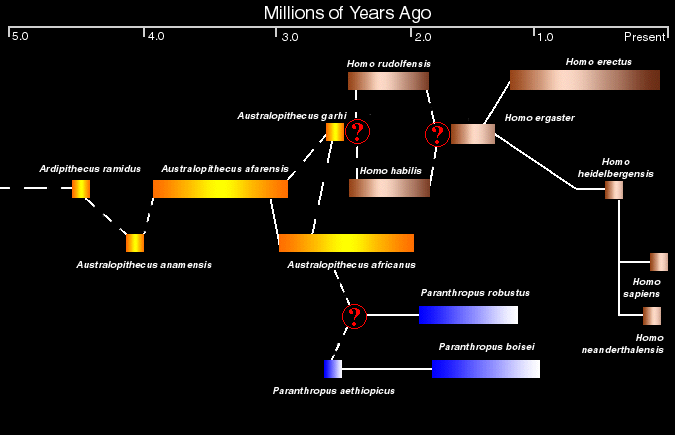
Early Human Phylogeny, Smithsonian National Museum of Natural HistoryI wouldn't go so far as to call evolution a religion, but I don't see how some people argue that evolution requires no faith at all to accept. I'm guessing that the vast majority of people in the United States couldn't succinctly define "evolution" much less logically defend it with strong factual evidence. My suspicion is that of those people most believe that the theory is an accurate descriptor of reality. That leads me to the conclusion that most people have faith in the theory or, barring that, faith in experts who believe the theory.

That's fine and good; most of us take as a matter of fact that the earth revolves around the sun even though we have no direct proof (we have to defer to cosmologists, physicists and mathematicians for that). We have faith in a lot of things that are, in reality, fact simply because we, as independent observers, cannot confirm or deny in a purely scientific manner. On a logical level, it may be justifiable to believe in evolution based on all available facts, but not to make fallacious appeals to belief (i.e., "evolution is true because I believe it to be") or appeals to authority (i.e., "Charles Darwin and Stephen Jay Gould believed in evolution, therefore I do").

So, what are we left with?

We are left with several facts about human evolution. Simply put, we possess the following facts about human origins (taken primarily from my old college text books, Reconstructing Human Origins, The Human Evolution Sourcebook, The Human Evulotion Sourcebook and Early Human Phylogeny, Smithsonian National Museum of Natural History):
1. There were several species of creatures who possessed anatomical similarities with modern humans and apes
2. These species had a geologic life span and then died off
3. Fully human (homo sapien sapien) appeared at a specific time in the past
You can infer several things from this in a logical way. Either, these species were related chronologically, one giving rise to another with various branches and dead ends, or, these creatures had similar design properties but are not directly related. Either conclusion is inductive; there's merely a probability that either is correct.

In addition the idea of a "missing link" or transitional form is purely subjective. You are free to interpret the data in a way which makes it likely that there is a genetic line between Australopithecus through to the Homo genus to modern man, but you have to admit that this is an interpretation of the facts, not the facts. (If Darwinian evolution is true, I'd expect to see no distinct species in the past, rather a blur of characteristics that defy classification.)

So back to the point: does evolution require faith? Dr. Roy W. Spencer, Principal Research Scientist, University of Alabama apparently does. I'd say that in general he is correct. Evolutionists believe in the unseen truth (untestable connections between Australopithecus and us today. There may indeed be connections there, but they are logical artifacts rather than concrete facts.

Labels: ,

Saturday, July 30, 2005

Statement of Faith

I believe in one personal, pre-existent, all-powerful God who created the universe and all that is found therein. This Creator God possess certain attributes indicative of personhood, among others, love, creativity, initiative, morality, need for companionship, decision making and rationality. I believe God wishes to be in relationship with His creation. I believe in additional (spiritual) dimensions beyond the physical universe, a reality which contains energies and beings which can affect our physical dimension either toward or away from God's love. I believe that the spiritual states of Heaven and Hell exist.

I believe that human beings were created fully formed--at some historical point--by God to be in relationship with Himself and to be of service to one another. Soon thereafter, humans made a decision to rebel from their spiritual nature and have ever since leaned morally toward selfishness and error, taking an apparent "short cut" to power and wholeness. Selfishness and error (rejection of God's will, truth and life) inevitably leads to physical and spiritual death. I believe human beings are endowed with radical free will, rationality and incalculable value. I believe that the general nature of humanity is unchanging, though individuals, cultures and societies are free to rise above the average or sink below at various times and places. I believe humans posses an eternal soul which will live on after physical death. I believe that there are two general classes to which humans can belong, the selfish, carnal, error-filled, temporal Kingdom of this World and the truth-seeking, eternally-minded, selfless Kingdom of Heaven. Though, we are told that the fruit of a person's life exposes which Kingdom they may belong to, our limited sensibilities prevents us from pursuing judgment too strongly in most cases. (We can only seek the truth as best we can and promote life, love and God's will where we can.) The existence after death is decided by the choices made during physical life.

I believe that, due to these conditions in the human race, God found it necessary to provide an avenue for salvation; that avenue is Jesus Christ. I believe Jesus was more than an example of a (the) spiritual life but rather the bridge between human selfishness and the wholeness of God. He was the perfect example of what it means to be fully human and fully divine. His life, teaching, ministry, death and resurrection came to pass in order to bring the Kingdom of God into the world. In essence, God sent Jesus to the world to demonstrate the truth and offer himself up as an invitation to depart from the Kingdom of Self and this World. I believe that, because of this free invitation to enter the Kingdom of Heaven and humanity's ability to make decisions, no human being, regardless of how depraved or evil, is excluded from entering a true relationship with God as long as they choose to freely enter; there are no hopeless cases.

I believe that final truth exists and through the God-given faculties of reason, wonder and reverence, despite our imperfections and the difficulties implied in the search, we humans can approach truth. Subjectivity is only the beginning of truth, not the end. I believe that the good life is an examined life.

Labels: ,